REM Sleep vs Deep Sleep: What Matters More for Your Health?
Introduction
Most people measure sleep by a single number: hours. Seven hours, eight hours — the assumption is that if enough time has passed, the body must be rested. But anyone who has woken up exhausted after a full night in bed knows that hours alone do not tell the whole story.
What actually determines how rested you feel — physically, mentally, and emotionally — is what happens inside those hours. Sleep is not a uniform state. It is a highly structured biological process made up of distinct stages, each serving functions that the others cannot replicate. Among these stages, two stand out as the most critical for health and performance: deep sleep and REM sleep.
Understanding the difference between these two stages, what each one does, and what happens when either is disrupted is one of the most practical things you can learn about your own health. It explains why you sometimes wake up physically exhausted but mentally sharp, or mentally foggy but physically fine — and it points directly toward what needs to change.
How Sleep Is Structured: The 90-Minute Cycle
Before comparing deep sleep and REM sleep, it helps to understand how they fit into the overall architecture of a night’s rest.
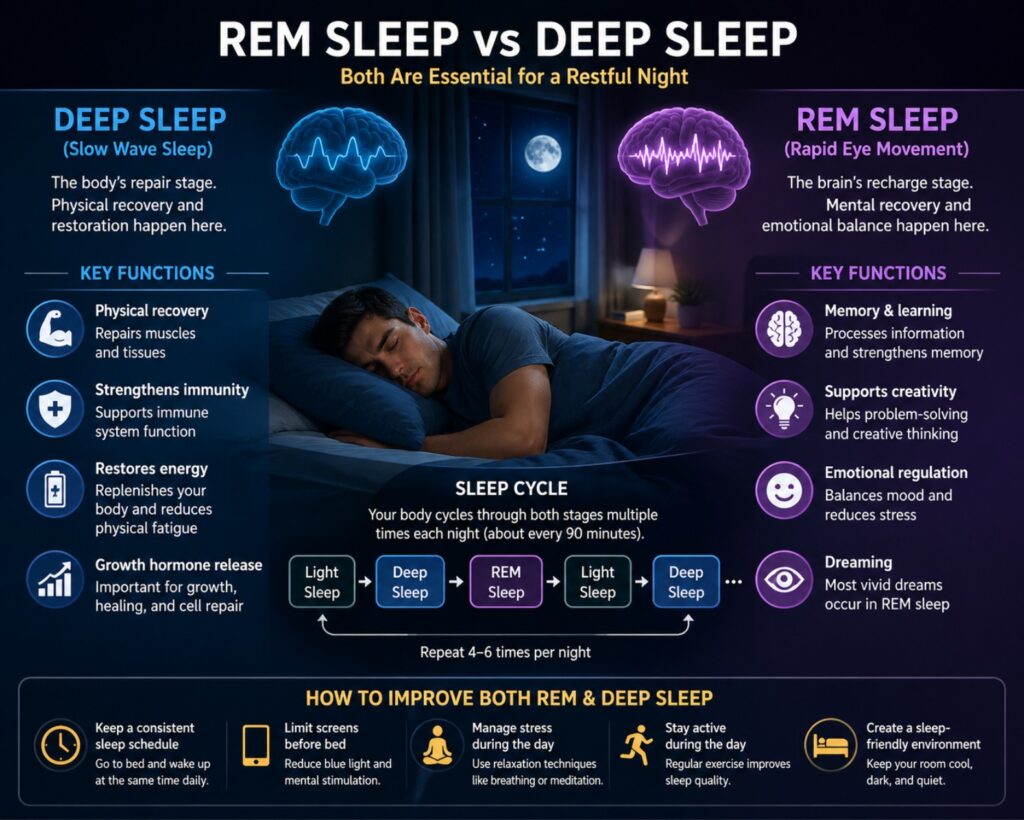
Sleep is organized into repeating cycles of approximately 90 minutes each. A typical night of seven to nine hours contains four to six of these cycles. Each cycle moves through a sequence of stages: two stages of light sleep, one stage of deep slow-wave sleep, and one stage of REM sleep.
The proportion of each stage shifts significantly across the night. Deep sleep dominates the first half of the night — the first two cycles contain the longest and most intense periods of slow-wave sleep. REM sleep becomes progressively longer in the second half of the night, with the final cycle before waking often containing 45 to 60 minutes of REM sleep.
This timing has critical implications. Cutting sleep short by even one or two hours disproportionately reduces REM sleep, since most REM occurs late in the sleep period. Alcohol and certain medications suppress REM sleep even when total sleep time appears adequate. Stress and an irregular sleep schedule tend to fragment deep sleep in the early cycles. Each disruption affects a different stage — and produces a different set of consequences.
What Is Deep Sleep?
Deep sleep — formally known as slow-wave sleep or Stage 3 NREM sleep — is characterized by large, synchronized delta waves sweeping across the cortex. It is the hardest stage to wake from and the most physically restorative period of the entire sleep cycle.
During deep sleep, several critical biological processes occur simultaneously. The pituitary gland releases the majority of the body’s daily growth hormone, which drives tissue repair, muscle recovery, and cellular regeneration. The immune system becomes highly active, producing and distributing cytokines — proteins that regulate immune responses and fight infection and inflammation. Core body temperature reaches its lowest point, and metabolic activity slows to its minimum.
Simultaneously, the brain’s glymphatic system — a waste-clearance network that operates primarily during deep sleep — becomes active. Cerebrospinal fluid flows through expanded channels between brain cells, flushing out metabolic waste products including beta-amyloid, the protein associated with Alzheimer’s disease. Research has shown that the brain clears significantly more waste during sleep than during wakefulness, and that this process is most efficient during slow-wave sleep.
Deep sleep also plays a role in declarative memory consolidation — the transfer of factual and event-based information from short-term hippocampal storage to long-term cortical memory. The slow oscillations of deep sleep coordinate communication between the hippocampus and the prefrontal cortex, strengthening neural connections formed during the day.
What Is REM Sleep?
REM sleep — Rapid Eye Movement sleep — is neurologically the most unusual stage of sleep. Brain activity during REM is nearly identical to wakefulness, with high-frequency, low-amplitude waves resembling those of an alert, engaged mind. Yet the body is in a state of near-complete muscle paralysis, a mechanism that prevents the physical acting out of dreams.
The functions of REM sleep are primarily cognitive and emotional rather than physical.
Memory consolidation during REM sleep focuses on procedural and associative memory — how to perform skills, and how seemingly unrelated pieces of information connect to one another. Research shows that REM sleep enhances the brain’s ability to recognize patterns and generate creative solutions, which is why complex problems often feel more approachable after a full night of sleep.
Emotional regulation is another core function of REM sleep. During this stage, the brain reprocesses emotional experiences from the day — effectively reducing emotional intensity while preserving memory. This supports emotional resilience and stress control.
When REM sleep is insufficient, emotional processing remains incomplete. This leads to higher reactivity, lower stress tolerance, and mood instability the next day.
Deep Sleep vs REM Sleep: Key Differences
Deep sleep and REM sleep serve complementary but distinct biological functions.
Deep sleep is primarily restorative for the body. It supports physical repair, immune function, and energy restoration.
REM sleep is primarily restorative for the mind. It supports memory, learning, emotional balance, and cognitive performance.
Deep sleep is associated with waking up physically refreshed.
REM sleep is associated with waking up mentally sharp.
Both are essential. There is no substitute for either stage.
Signs You Are Not Getting Enough Deep Sleep
Physical fatigue despite enough hours of sleep is the most common sign. You may feel heavy, slow, or unrefreshed in the morning. Muscle soreness, low energy, and frequent illness can also indicate low deep sleep.
Signs You Are Not Getting Enough REM Sleep
Cognitive symptoms are more noticeable. You may experience poor focus, memory issues, irritability, or emotional instability. Even if you sleep enough hours, your mind may not feel recovered.
What Disrupts Each Stage
Alcohol suppresses REM sleep and increases nighttime awakenings.
Stress increases cortisol, which reduces deep sleep.
Irregular sleep schedules disrupt both stages.
Screen use before bed delays sleep onset and reduces overall sleep quality.
How to Protect Both Stages
Maintain a consistent wake-up time every day.
Avoid alcohol close to bedtime.
Reduce caffeine in the afternoon.
Create a cool, dark, and quiet sleep environment.
Manage stress before bed with simple relaxation techniques.
Sleep long enough to complete full sleep cycles.
Conclusion
Deep sleep and REM sleep are not competing stages. They are both essential parts of a complete recovery system.
Deep sleep restores your body. REM sleep restores your mind.
To feel truly rested, you need both.
By improving your sleep habits and protecting your sleep cycles, you can improve not just how long you sleep, but how well you recover.
Better sleep is not just about more hours — it is about better quality.