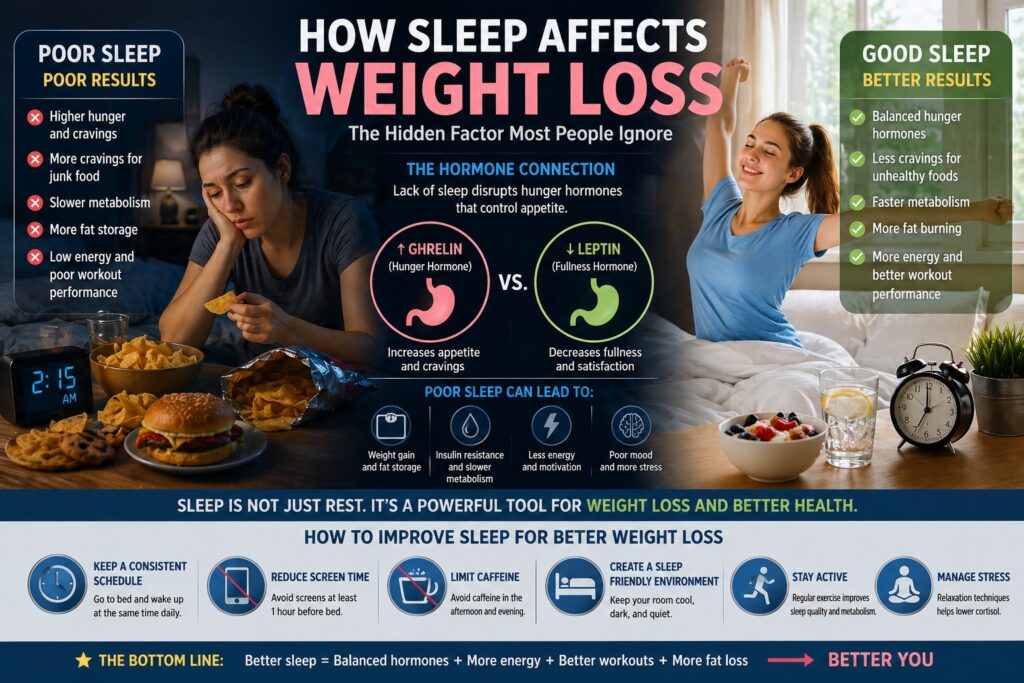
How Sleep Affects Weight Loss (The Hidden Factor Most People Ignore)
Introduction
If you have ever committed to a diet, tracked your calories carefully, exercised consistently, and still struggled to lose weight — sleep may be the missing piece of the equation.
For decades, the conversation around weight loss has centered almost entirely on two variables: food intake and physical activity. Eat less, move more. While both matter, this framework leaves out a third factor that research has increasingly shown to be equally important — and in some cases, more important than either of the other two.
Sleep governs the hormones that control your hunger, the way your body partitions energy between fat storage and fat burning, the effectiveness of your workouts, and your ability to make consistent, healthy food choices. Without adequate sleep quality, the biological environment of your body actively resists fat loss — regardless of how disciplined your diet or how rigorous your training.
This is not a matter of willpower or motivation. It is physiology. Understanding exactly how sleep affects weight loss is one of the most powerful steps you can take toward improving your results — and explaining why your current efforts may not be producing the outcomes you expect.
The Hormone Connection: Ghrelin, Leptin, and the Biology of Hunger
Appetite is not simply a matter of choice. It is regulated by a complex system of hormones that signal hunger and satiety to the brain. Two of the most important are ghrelin and leptin — and both are directly disrupted by poor sleep.
Ghrelin is the primary hunger-stimulating hormone. It is produced in the stomach and signals to the brain that it is time to eat. Ghrelin levels naturally rise before meals and fall after eating. When sleep is insufficient, ghrelin production increases — sometimes significantly.
Leptin is the hormone responsible for satiety. It is produced by fat cells and signals to the hypothalamus that the body has sufficient energy stores and does not need additional food. When sleep is adequate, leptin levels remain stable and appropriately suppress appetite. When sleep is poor, leptin levels drop, removing the biological brake on hunger.
The combined effect of elevated ghrelin and reduced leptin is a powerful and persistent drive to eat more than the body actually needs. A landmark study involving over 1,000 participants found that those who slept fewer than eight hours per night had higher ghrelin levels, lower leptin levels, and a higher body mass index than those who slept adequately — with the hormonal differences directly proportional to the degree of sleep restriction.
A separate study found that just two nights of sleep restriction reduced leptin by 18 percent and increased ghrelin by 28 percent, producing a 24 percent increase in appetite and a particularly strong increase in cravings for calorie-dense, high-carbohydrate foods. These were not modest changes. They represented a fundamental shift in the hormonal environment governing food intake — driven entirely by sleep deprivation.
Why You Crave Junk Food When You Are Tired
The hormonal changes described above are compounded by a parallel effect on brain function. Sleep deprivation impairs the prefrontal cortex — the region responsible for impulse control, long-term decision-making, and the ability to weigh consequences — while simultaneously increasing activity in the brain’s reward centers, particularly those that respond to food.
Research using brain imaging has shown that sleep-deprived individuals display greater activation in reward-related regions when exposed to high-calorie foods. The foods that trigger the strongest response — sugary snacks, fast food, and processed items — are exactly the ones most likely to interfere with weight loss.
This means sleep deprivation not only makes you hungrier, but also makes unhealthy food more appealing while reducing your ability to resist it.
Sleep and Metabolism: Insulin Sensitivity and Energy Storage
Sleep also plays a critical role in how your body processes energy.
Insulin is the hormone responsible for helping cells absorb glucose from the bloodstream. When insulin sensitivity is high, your body uses energy efficiently. When it is low, your body stores more energy as fat.
Research has shown that even a few nights of poor sleep can significantly reduce insulin sensitivity. This creates a metabolic environment that favors fat storage over fat burning, even if your calorie intake remains the same.
Over time, this can increase the risk of weight gain and metabolic disorders.
Fat Loss vs Muscle Loss: Why Sleep Quality Changes What You Lose
Weight loss is not just about losing weight — it is about losing fat while preserving muscle.
Research comparing well-rested individuals to sleep-deprived individuals on identical diets found that those with insufficient sleep lost significantly less fat and more muscle mass.
Muscle is metabolically active and plays a key role in maintaining a healthy metabolism. Losing muscle slows down your metabolism, making future fat loss more difficult.
This means poor sleep can reduce the effectiveness of your diet, even if you are losing weight overall.
Cortisol, Stress, and Fat Storage
Sleep deprivation increases cortisol, the body’s primary stress hormone.
High cortisol levels promote fat storage, particularly in the abdominal area. They also increase appetite and cravings for high-calorie foods.
This creates a cycle where poor sleep leads to higher stress, which leads to more fat storage and further sleep disruption.
Breaking this cycle requires improving sleep, not just diet or exercise.
Sleep and Exercise Performance
Sleep affects your ability to exercise effectively.
When you are sleep-deprived, your energy levels drop, your performance decreases, and your motivation declines.
This can lead to fewer workouts, lower intensity training, and slower recovery.
Over time, this reduces the overall effectiveness of your weight loss efforts.
Sleep supports consistency, which is one of the most important factors in long-term results.
How Much Sleep Do You Need for Effective Weight Loss?
Most research suggests that adults need between seven and nine hours of sleep per night for optimal health.
Sleeping fewer than six hours consistently is associated with increased weight gain and metabolic issues.
However, sleep quality is just as important as duration.
Interrupted or poor-quality sleep can have similar negative effects as not getting enough sleep at all.
Consistency in your sleep schedule plays a major role in maintaining proper hormonal balance.
Practical Steps to Improve Sleep for Better Weight Loss Results
Improving sleep does not require drastic changes.
Maintain a consistent sleep schedule.
Reduce screen time before bed.
Avoid caffeine in the afternoon.
Create a cool, dark, and quiet sleep environment.
Stay physically active during the day.
These habits help regulate hormones and improve both sleep and weight loss results.
Conclusion
Weight loss is not just about diet and exercise.
Sleep plays a critical role in how your body regulates hunger, stores fat, and uses energy.
Without adequate sleep, your body works against your efforts.
Improving sleep can make weight loss easier, more effective, and more sustainable.
Better sleep is not optional. It is a key part of the process.