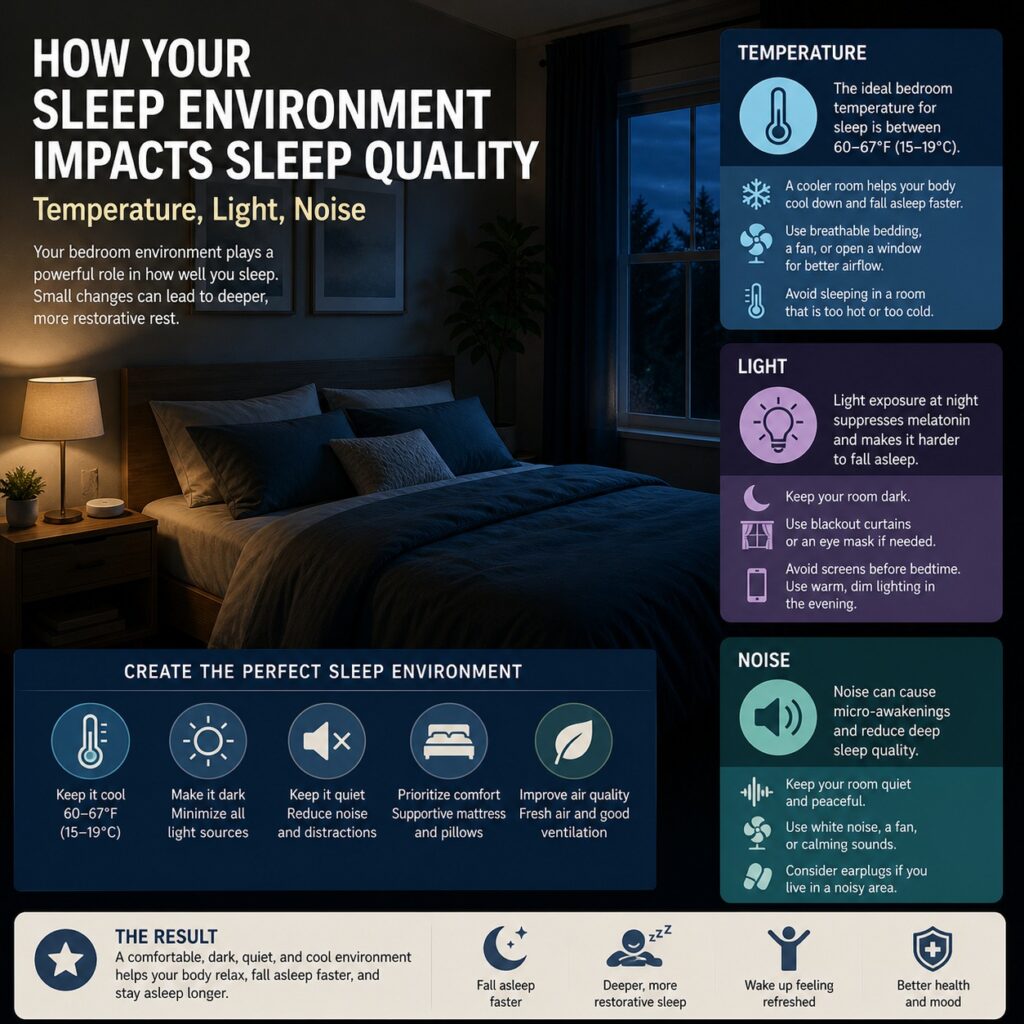
How Your Sleep Environment Impacts Sleep Quality (Temperature, Light, Noise)
Introduction
Most sleep advice focuses on behavior — what time to go to bed, how to wind down, what to avoid before sleep. But there is a dimension of sleep quality that receives far less attention, despite having a direct and measurable impact on how deeply you sleep every night: the physical environment you sleep in.
Your brain does not fully disengage from its surroundings during sleep. It continues monitoring the environment throughout the night, processing sensory input and adjusting sleep depth in response to what it detects. Light, temperature, noise, air quality, and physical comfort all send continuous signals to the sleeping brain — signals that determine whether it stays in deep, restorative sleep stages or surfaces toward lighter, more fragmented sleep.
This matters because the difference between a well-optimized and a poorly optimized sleep environment is not subtle. Environmental factors can reduce time spent in deep sleep, increase nighttime awakenings, and cause next-day fatigue even when total sleep time appears sufficient.
The encouraging part is that environmental improvements are often simple and highly effective. Unlike habits that require long-term discipline, these are usually one-time adjustments that deliver immediate benefits.
Temperature: The Most Important Factor
Temperature is one of the most critical yet overlooked aspects of sleep quality.
Your body needs to lower its core temperature to fall asleep. This cooling process is part of your natural circadian rhythm. If your bedroom is too warm, your body struggles to complete this process, making it harder to fall asleep and stay asleep.
Research suggests that the ideal bedroom temperature is between 60 and 67 degrees Fahrenheit (15 to 19 degrees Celsius). Within this range, your body can regulate temperature effectively and enter deeper stages of sleep.
Using breathable bedding materials such as cotton or linen helps prevent overheating. A fan or proper ventilation can further support temperature control.
Light: The Strongest Signal to Your Brain
Light plays a powerful role in regulating sleep.
Your brain uses light to determine whether it is time to be awake or asleep. Exposure to light at night suppresses melatonin, the hormone responsible for sleep.
Even small amounts of light can have an impact. Streetlights, electronic devices, and indoor lighting can all interfere with melatonin production.
Creating a dark environment supports better sleep. Blackout curtains or a sleep mask can significantly improve sleep quality.
Dimming lights in the evening and avoiding screens before bed can also help your body prepare for sleep.
Noise: The Hidden Sleep Disruptor
Noise can disrupt sleep even if you do not fully wake up.
Sudden or irregular sounds trigger brief awakenings that reduce sleep quality. These interruptions often go unnoticed but still affect how rested you feel in the morning.
Consistent background noise, such as white noise or a fan, can help mask disruptive sounds.
The key is consistency. A steady sound environment is less disruptive than unpredictable noise.
In noisy environments, earplugs can provide additional protection.
Physical Comfort
Comfort plays a major role in sleep quality.
An uncomfortable mattress or pillow can cause frequent movement during the night. This disrupts sleep cycles and reduces deep sleep.
Proper spinal alignment is important. Your mattress and pillow should support your body in a neutral position.
Side sleepers, back sleepers, and stomach sleepers all require different levels of support.
If replacing a mattress is not possible, a quality mattress topper can improve comfort significantly.
Air Quality
Air quality is often overlooked but still important.
Poor ventilation can make a room feel stuffy and uncomfortable. This can affect breathing and sleep continuity.
Maintaining proper humidity levels and allowing fresh air into the room can improve sleep conditions.
Even simple actions like opening a window or using a fan can make a noticeable difference.
The Bedroom-Sleep Connection
Your brain forms associations based on repeated behavior.
If your bedroom is used only for sleep, your brain learns to associate it with rest.
If you use your bed for work, watching videos, or other activities, this association weakens.
Keeping your bedroom simple and dedicated to sleep strengthens your body’s natural sleep response.
Avoid clutter and reduce unnecessary stimulation in your sleeping space.
Conclusion
Your sleep environment is not just a background detail. It actively shapes how well you sleep each night.
Temperature, light, noise, comfort, and air quality all influence your sleep quality.
Improving these factors can lead to deeper, more restorative sleep without changing your schedule or habits dramatically.
Better sleep is not always about doing more. Sometimes, it is about adjusting the environment around you.