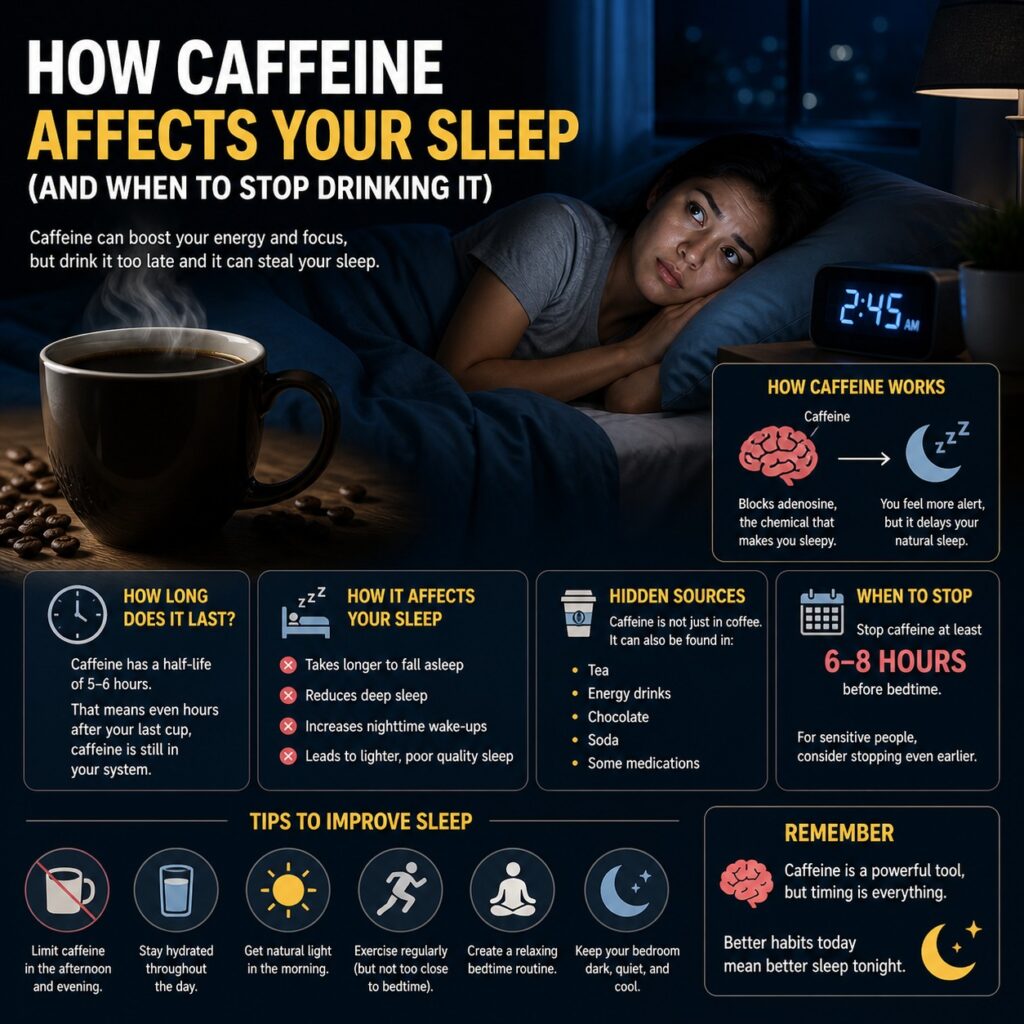
How Caffeine Affects Your Sleep (And When to Stop Drinking It)
Introduction
For most people, caffeine is the first thing that enters their body in the morning and, in many cases, far from the last. Coffee, tea, energy drinks, pre-workout supplements, afternoon sodas, and evening chocolate — caffeine is woven into daily life in ways that most people do not fully track.
It is one of the most studied psychoactive substances in the world, and its short-term benefits are well established. Caffeine improves alertness, enhances focus, reduces perceived effort during physical activity, and temporarily elevates mood. Used strategically, it is a genuinely useful cognitive and performance tool.
The problem is that the same mechanism that makes caffeine effective during the day does not switch off when you decide it is time to sleep. Caffeine consumed hours before bed continues to actively interfere with the biological processes that initiate and sustain quality sleep — often without the person being aware of the connection. Many people who struggle with falling asleep, waking during the night, or feeling unrested in the morning are experiencing the direct effects of caffeine consumed earlier in the day.
Understanding exactly how caffeine affects sleep biology — and making informed decisions about timing and quantity — is one of the simplest and highest-impact changes available for improving sleep quality.
How Caffeine Works: The Adenosine System
To understand caffeine’s effect on sleep, you need to understand adenosine — the molecule at the center of the relationship between wakefulness and sleep pressure.
Adenosine is a byproduct of neural activity that accumulates in the brain throughout the day as a natural consequence of being awake and mentally active. As adenosine levels rise, it binds to receptors in the brain that progressively increase the subjective feeling of tiredness and the biological drive to sleep. By the time evening arrives, adenosine accumulation has built sufficient sleep pressure to make falling asleep relatively easy for most people.
Caffeine works by blocking adenosine receptors — physically occupying the binding sites that adenosine would otherwise attach to. With its receptors blocked, adenosine cannot signal tiredness to the brain, and the subjective experience of sleepiness is suppressed. This is why caffeine produces feelings of alertness and energy: it is not adding stimulation so much as temporarily removing the brake on wakefulness.
This distinction matters for understanding caffeine’s sleep effects. Caffeine does not destroy adenosine or reset sleep pressure — it merely delays its effect. The adenosine that has been building throughout the day continues to accumulate while caffeine is active. When caffeine eventually wears off and receptor blockade is lifted, the accumulated adenosine binds rapidly and in quantity, producing the familiar caffeine crash — a sudden, often intense wave of fatigue that can feel disproportionate to the level of tiredness before the caffeine was consumed.
More critically for sleep, if caffeine is still partially active when you go to bed, it continues to block adenosine receptors during the night — reducing the brain’s ability to fully enter and sustain the deeper stages of sleep, even if sleep onset itself is not noticeably delayed.
How Long Caffeine Stays in Your System
One of the most consequential and most underestimated facts about caffeine is its pharmacological half-life — the time it takes for the body to eliminate half of the caffeine present in the bloodstream.
The average half-life of caffeine in a healthy adult is five to six hours. This means that if you consume 200 milligrams of caffeine at 2 PM, approximately 100 milligrams remains active in your system at 8 PM. At 11 PM, approximately 50 milligrams is still present. Even at midnight, residual caffeine activity continues to influence brain function.
This half-life is an average, and individual variation is significant. Genetic differences in the CYP1A2 enzyme — the primary enzyme responsible for caffeine metabolism in the liver — mean that some people metabolize caffeine twice as fast as others, while some metabolize it significantly more slowly. Women taking oral contraceptives metabolize caffeine more slowly, as do people with certain liver conditions. Smokers metabolize caffeine faster than non-smokers. Pregnant women metabolize caffeine far more slowly, with a half-life that can extend to 15 hours or more in the third trimester.
This variability explains why one person can drink coffee after dinner and sleep without apparent difficulty, while another person is still affected by a mid-afternoon espresso at midnight. Neither experience is wrong — they reflect genuine biological differences in how quickly caffeine is cleared. The practical implication is that the appropriate caffeine cutoff time is individual, and people who are sensitive metabolizers may need to stop consuming caffeine significantly earlier than standard recommendations suggest.
How Caffeine Affects Sleep Quality
The most important and least appreciated aspect of caffeine’s relationship with sleep is that it damages sleep quality even when it does not appear to affect sleep onset. Many people conclude that caffeine does not affect their sleep because they fall asleep without difficulty — but falling asleep is only one dimension of sleep quality.
Research has shown that caffeine consumed six hours before bedtime can significantly reduce total sleep time and sleep quality, even when people do not notice immediate difficulty falling asleep. The disruption happens at the level of sleep architecture — the internal structure of sleep stages — rather than sleep onset.
Specifically, caffeine reduces the proportion of deep slow-wave sleep. This is the most physically restorative stage of sleep, responsible for tissue repair, immune function, and energy restoration. Reduced deep sleep produces the physical fatigue and mental grogginess commonly associated with poor sleep.
Caffeine also increases the frequency of brief nighttime awakenings by maintaining a baseline level of neural arousal. These awakenings are often too short to remember but still reduce overall sleep quality.
The result is a cycle: poor sleep leads to fatigue, fatigue leads to more caffeine, and more caffeine leads to worse sleep.
Hidden Sources of Caffeine
Many people underestimate their caffeine intake because they only consider coffee.
Caffeine is also found in tea, energy drinks, chocolate, and certain medications.
Black tea can contain 40 to 70 milligrams per cup.
Green tea contains 20 to 45 milligrams.
Energy drinks can contain over 200 milligrams per serving.
Dark chocolate also contains caffeine, especially in higher cocoa percentages.
Even decaffeinated coffee is not completely caffeine-free.
Being aware of these sources is important when trying to improve sleep.
Individual Sensitivity and Variation
People respond to caffeine differently.
Some metabolize it quickly and feel little effect. Others are highly sensitive and experience sleep disruption even from small amounts.
Tolerance can reduce the noticeable alertness from caffeine, but it does not fully reduce its impact on sleep quality.
Age, genetics, and stress levels all influence how caffeine affects your body.
When to Stop Drinking Caffeine
A general guideline is to stop caffeine at least six to eight hours before bedtime.
For a typical bedtime of 11 PM, this means avoiding caffeine after 3 PM.
Sensitive individuals may need to stop even earlier.
Adjusting your cutoff time based on how your body responds is the most effective approach.
How to Reduce Caffeine Without Losing Energy
Reducing caffeine gradually can help avoid withdrawal symptoms.
Switch to lower-caffeine alternatives like green tea.
Drink more water.
Improve sleep quality to reduce reliance on caffeine.
Better energy comes from better sleep, not more stimulation.
Conclusion
Caffeine is a useful tool when used correctly.
However, its long-lasting effects can interfere with sleep in ways many people do not realize.
By understanding how caffeine works and adjusting your intake, you can improve both your sleep quality and your daily energy levels.
Better sleep often starts with reducing what keeps you awake.