How to Fix Sleep Problems Naturally (Without Medication)
Introduction
Sleep problems are among the most common health complaints in the world — and among the most commonly medicated.
Prescription sleep aids and over-the-counter sleep medications are used by millions of people nightly, often as a first response to difficulty sleeping rather than a last resort.
Yet research consistently shows that while sleep medications may help temporarily, they do not create the natural sleep architecture required for genuine recovery. They also carry risks of dependency, tolerance, and long-term reduced effectiveness.
The good news is that many of the most effective long-term treatments for sleep problems are completely natural.
Cognitive Behavioral Therapy for Insomnia (CBT-I) consistently outperforms sleep medication in long-term outcomes because it addresses the underlying causes of sleep disruption rather than temporarily suppressing symptoms.
This guide explains the most effective natural ways to improve sleep quality, restore healthy sleep patterns, and rebuild the biological systems required for deep restorative sleep.
Understanding Why Sleep Problems Develop
Acute Sleep Problems vs Chronic Sleep Problems
Most long-term sleep problems begin with a short-term trigger:
- stress
- illness
- travel
- shift work
- emotional events
- schedule disruption
Temporary sleep disruption is normal.
The problem develops when temporary sleep difficulty becomes chronic.
The Behavioral Cycle That Worsens Sleep
After several poor nights, people often begin making understandable but counterproductive adjustments:
- spending too much time in bed
- sleeping in
- napping excessively
- reducing daytime activity
- staying in bed while awake
These habits weaken sleep pressure and destabilize circadian rhythm timing.
Sleep Anxiety and Hyperarousal
Many people also develop anxiety specifically about sleep itself.
They begin:
- worrying about sleep
- monitoring their body constantly
- clock-watching at night
- fearing the consequences of poor sleep
This anxiety activates stress hormones like cortisol and adrenaline, directly opposing the relaxed physiological state sleep requires.
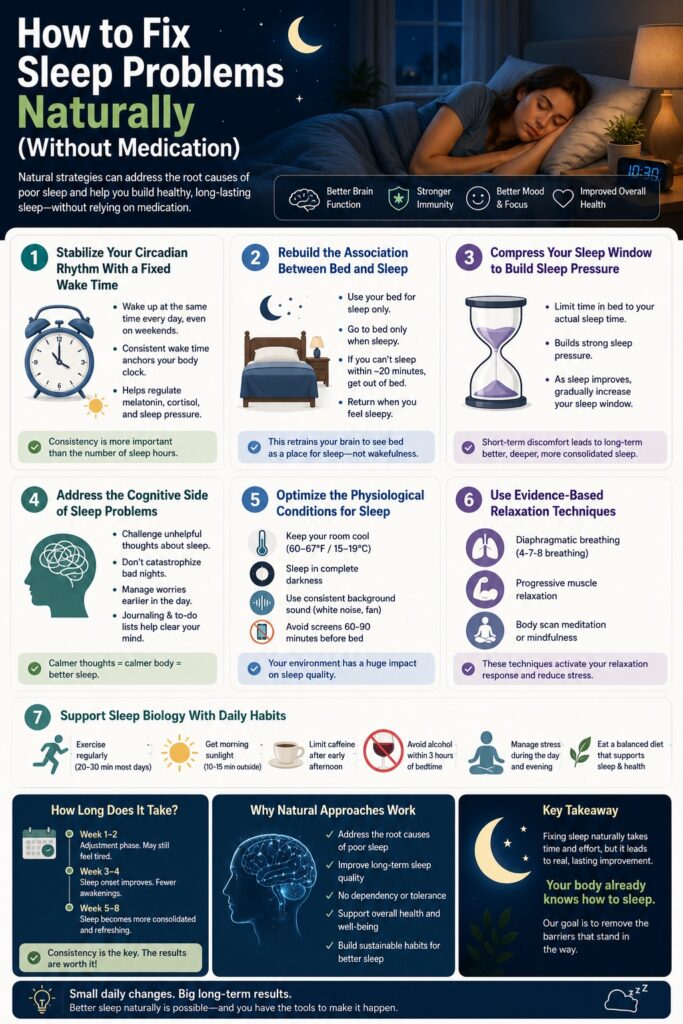
1. Stabilize Your Circadian Rhythm With a Fixed Wake Time
Why Wake Time Matters More Than Bedtime
The most powerful natural sleep intervention is maintaining a consistent wake time every day.
Your circadian rhythm depends heavily on wake timing.
A stable wake time helps regulate:
- melatonin release
- cortisol rhythm
- sleep pressure
- evening sleepiness
Sleeping in after poor sleep often worsens future sleep quality instead of fixing it.
How Sleep Pressure Works
Adenosine builds throughout the day and creates the biological urge for sleep.
Consistent wake timing allows sleep pressure to build naturally and predictably.
Irregular schedules weaken this process and make sleep less reliable.
2. Rebuild the Association Between Bed and Sleep
Why the Brain Stops Associating Bed With Sleep
The brain forms associations through repetition.
When the bed becomes associated with:
- scrolling on phones
- watching TV
- worrying
- lying awake frustrated
the brain stops recognizing the bed as a strong sleep cue.
Stimulus Control Therapy
One of the most effective CBT-I techniques is stimulus control.
Core rules include:
- use the bed only for sleep
- go to bed only when sleepy
- leave the bed if unable to sleep
- return only when genuine sleepiness returns
This retrains the nervous system to reconnect the bed with sleep rather than wakefulness.
3. Compress Your Sleep Window to Build Sleep Pressure
What Sleep Restriction Therapy Is
Sleep restriction therapy temporarily limits time spent in bed to strengthen sleep pressure and improve sleep consolidation.
This sounds counterintuitive but is highly evidence-based.
People with insomnia often spend excessive time in bed while sleeping poorly.
This fragments sleep further.
Why Sleep Compression Works
Reducing time in bed temporarily increases:
- sleep pressure
- sleep efficiency
- deep sleep intensity
Over time, sleep becomes more consolidated and restorative.
4. Address the Cognitive Side of Sleep Problems
How Thoughts Affect Sleep Physiology
Thoughts directly affect nervous system activation.
Common harmful thought patterns include:
- catastrophizing poor sleep
- fear of insomnia
- performance anxiety around sleep
- obsessing over sleep hours
These thoughts increase cortisol and hyperarousal.
Cognitive Restructuring
CBT-I teaches people to replace exaggerated sleep fears with more realistic interpretations.
For example:
- one poor night is usually survivable
- temporary wakefulness is normal
- forcing sleep increases stress
Reducing fear around sleep often improves sleep naturally.
Pre-Sleep Worry Management
Scheduling worry time earlier in the day helps reduce bedtime rumination.
Helpful techniques include:
- journaling
- to-do lists
- brain dumps
- gratitude reflection
These reduce cognitive overload at night.
5. Optimize the Physiological Conditions for Sleep
Bedroom Temperature
Most people sleep best between:
60–67°F (15–19°C)
Cool temperatures support deep sleep and nighttime thermal regulation.
Darkness and Melatonin
Even small amounts of light suppress melatonin.
Helpful tools include:
- blackout curtains
- sleep masks
- dim evening lighting
Noise Control
Consistent background sound often improves sleep more than inconsistent silence interrupted by sudden noise.
Helpful options:
- white noise
- pink noise
- fans
Reduce Evening Screen Exposure
Screens suppress melatonin and overstimulate the brain.
Reducing screen use 60–90 minutes before bed improves sleep onset significantly.
6. Use Evidence-Based Relaxation Techniques
Diaphragmatic Breathing
Slow breathing activates the parasympathetic nervous system and reduces stress activation.
Popular techniques include:
- 4-7-8 breathing
- physiological sighs
- box breathing
Progressive Muscle Relaxation
Systematically relaxing muscle groups reduces physical tension and nervous system activation.
This is highly effective for stress-related insomnia.
Body Scan Meditation
Body scanning shifts attention away from racing thoughts and toward physical sensation.
This often reduces cognitive hyperarousal before sleep.
7. Support Sleep Biology With Daily Habits
Exercise Regularly
Moderate exercise improves:
- deep sleep
- stress regulation
- sleep pressure
- circadian rhythm stability
Morning and afternoon exercise generally work best.
Get Morning Sunlight
Morning sunlight exposure helps regulate:
- melatonin timing
- cortisol rhythm
- daytime alertness
Even 10–15 minutes outside helps significantly.
Limit Caffeine Late in the Day
Late caffeine reduces deep sleep quality even when people fall asleep normally.
Early afternoon cutoffs are ideal for sensitive sleepers.
Avoid Alcohol Before Bed
Alcohol fragments sleep architecture and suppresses REM sleep.
Sleep may feel easier initially but recovery quality worsens significantly.
How Long Natural Sleep Recovery Takes
Natural sleep recovery works more slowly than medication but produces far more sustainable improvements.
Most people notice:
- initial improvements within 2–4 weeks
- stronger sleep consolidation within 4–8 weeks
Consistency matters more than perfection.
Conclusion
Sleep problems are rarely caused by a lack of sleeping pills.
Most chronic sleep difficulties result from disruptions in:
- circadian rhythm
- nervous system regulation
- sleep pressure
- environmental conditions
- stress physiology
- behavioral conditioning
Natural sleep recovery focuses on restoring these systems rather than chemically suppressing symptoms temporarily.
Fixing sleep naturally requires patience and consistency.
But the long-term result is something medication alone rarely provides:
Reliable, self-sustaining, biologically restorative sleep.
Your body already knows how to sleep.
The goal is removing the obstacles preventing it from doing so.
📌 Tags
How to Fix Sleep Problems Naturally, Natural Sleep Remedies, Better Sleep, Sleep Tips, CBT-I, Sleep Science, Natural Insomnia Treatment, Deep Sleep, Sleep Recovery, Circadian Rhythm, Stress and Sleep, Sleep Hygiene, Healthy Sleep Habits, Sleep Without Medication, Nervous System Recovery