Introduction
Lying in bed unable to fall asleep can quickly become frustrating.
You close your eyes, try to relax, and wait for sleep to come. But minutes pass, and your mind becomes more active instead of calmer.
Most people respond by trying harder to sleep. Unfortunately, this usually makes the problem worse.
Sleep is not something you can force. It is something your body allows when the conditions are right.
Understanding what to do when you cannot fall asleep can help you break this cycle.
Why Staying in Bed Can Make It Worse
When you stay in bed awake for too long, your brain begins to associate the bed with wakefulness instead of sleep.
This weakens the connection between your bed and rest.
Over time, your body becomes more alert when you lie down.
This makes falling asleep even harder in the future.
This is why sleep experts recommend getting out of bed if you cannot fall asleep within about 20 minutes.
What You Should Do Instead
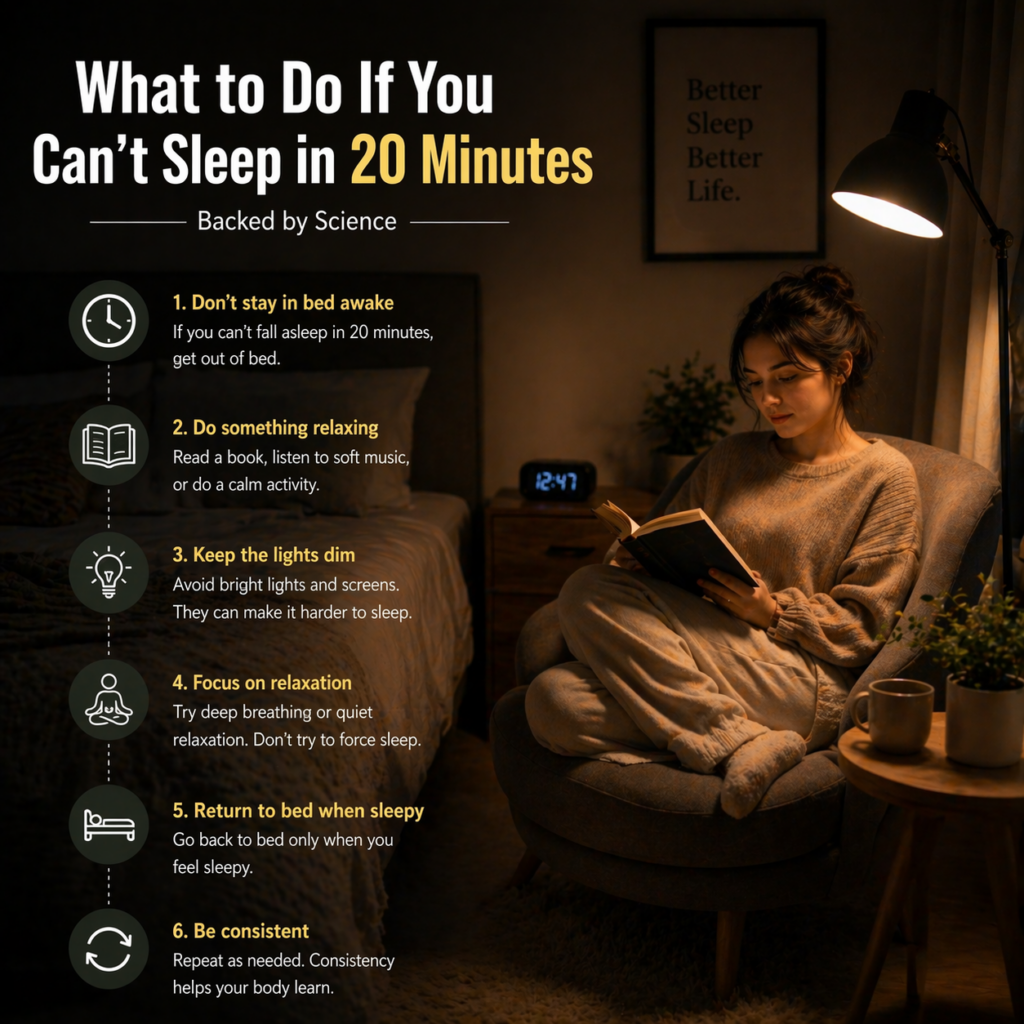
If you cannot fall asleep, get out of bed.
Move to another room or a quiet area with low lighting.
Choose an activity that is calm and not stimulating.
Examples include reading a book, listening to soft music, or sitting quietly.
The goal is to allow your body to relax naturally.
Avoid Bright Light and Screens
Light signals wakefulness to your brain.
Turning on bright lights or using your phone can delay sleep even further.
Keep the lighting dim and avoid screens.
This helps your body remain in a sleep-ready state.
Focus on Relaxation, Not Sleep
Trying to force sleep creates pressure.
Pressure leads to frustration, which increases alertness.
Instead of trying to sleep, focus on relaxing your body and mind.
Slow breathing can help.
Let sleep come naturally.
Return to Bed When You Feel Sleepy
Go back to bed only when you feel genuinely sleepy.
This strengthens the association between your bed and sleep.
If you still cannot sleep, repeat the process.
Consistency is key.
Common Mistakes to Avoid
Many people make simple mistakes that worsen sleep problems.
Checking the time repeatedly increases stress.
Using your phone stimulates your brain.
Staying in bed too long creates negative associations.
Avoiding these behaviors helps improve sleep.
How Long It Takes to Work
This method may not work immediately.
However, with consistency, your body learns to associate your bed with sleep again.
Most people notice improvement within one to two weeks.
Patience is important.
Why This Method Works
This approach is based on sleep science.
It is often used in cognitive behavioral therapy for insomnia.
By changing your behavior, you retrain your brain.
Over time, falling asleep becomes easier.
Conclusion
Not being able to fall asleep is common, but it can be managed.
The key is not to force sleep but to create the right conditions.
By leaving the bed when needed and focusing on relaxation, you can improve your sleep naturally.
Better sleep comes from better habits.