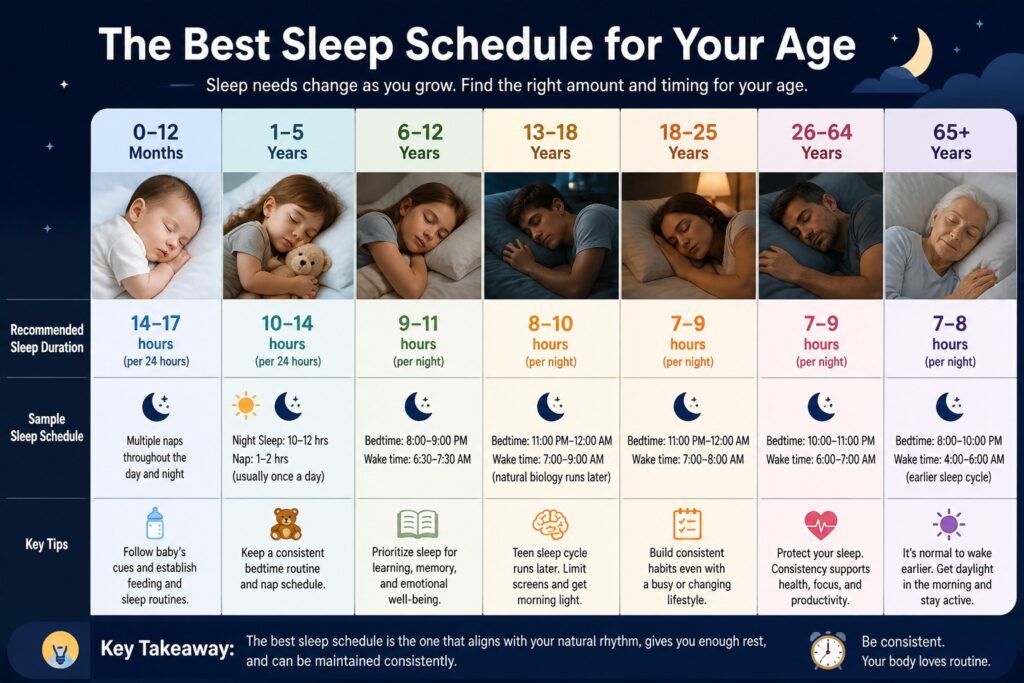
The Best Sleep Schedule for Your Age
Introduction
Sleep is not one-size-fits-all. The amount of sleep you need, the times you naturally feel sleepy and alert, and the internal structure of your sleep all change significantly across the course of a lifetime. A sleep schedule that works perfectly for a teenager is biologically inappropriate for a middle-aged adult. The sleep patterns of a new parent are fundamentally different from those of a retired grandparent — and not just because of lifestyle differences.
These changes are not random. They are driven by predictable shifts in circadian biology, hormonal systems, and sleep architecture that occur at specific life stages. Understanding how sleep needs and patterns change with age allows you to build a schedule that works with your biology rather than against it.
How Sleep Changes Across the Lifespan
Sleep changes in two main ways as you age: how much you need and when you feel sleepy.
Sleep duration is highest in infancy and gradually decreases into adulthood.
Circadian timing also shifts. Teenagers naturally stay up later, while older adults tend to sleep earlier and wake earlier.
These changes are biological, not just lifestyle choices.
Newborns and Infants (0 to 12 Months): 14 to 17 Hours
Infants need the most sleep because of rapid brain development.
They sleep in short cycles throughout the day and night because their internal clock is not fully developed.
By around 3 to 6 months, sleep begins to consolidate into longer nighttime periods.
Toddlers and Preschoolers (1 to 5 Years): 10 to 14 Hours
Young children still need a large amount of sleep.
They typically have one daytime nap that gradually disappears as they grow older.
Consistent routines are important at this stage.
Regular sleep schedules support emotional and behavioral development.
School-Age Children (6 to 12 Years): 9 to 11 Hours
Sleep is essential for learning and development.
Children who do not get enough sleep often show reduced attention and increased irritability.
A consistent bedtime and wake time improve both sleep quality and school performance.
Teenagers (13 to 18 Years): 8 to 10 Hours
Teenagers naturally experience a shift in their sleep cycle.
They feel sleepy later at night and prefer to wake up later in the morning.
This is a biological change, not a lack of discipline.
Early school schedules often conflict with this natural rhythm, leading to sleep deprivation.
Young Adults (18 to 25 Years): 7 to 9 Hours
Sleep patterns begin to stabilize in early adulthood.
Most people function best with a consistent schedule and sufficient sleep duration.
However, lifestyle factors often lead to irregular sleep habits in this age group.
Adults (26 to 64 Years): 7 to 9 Hours
Sleep needs remain relatively stable during adulthood.
The main challenge is maintaining consistency due to work and lifestyle demands.
Chronic sleep deprivation can lead to long-term health issues.
Protecting sleep is essential for overall health.
Older Adults (65 and Above): 7 to 8 Hours
Older adults often experience lighter and more fragmented sleep.
They tend to go to bed earlier and wake earlier.
This shift is normal and should be respected rather than resisted.
Improving the sleep environment can help maintain sleep quality.
Building the Right Sleep Schedule
Regardless of age, consistency is key.
Waking up at the same time every day helps regulate your internal clock.
Setting a bedtime based on your wake time ensures you get enough sleep.
Listening to your body’s natural sleep signals improves sleep quality.
Conclusion
Your ideal sleep schedule depends on your age and biology.
Understanding these changes allows you to create a routine that supports better sleep.
Better sleep leads to better energy, focus, and overall health.
The key is to work with your body, not against it.