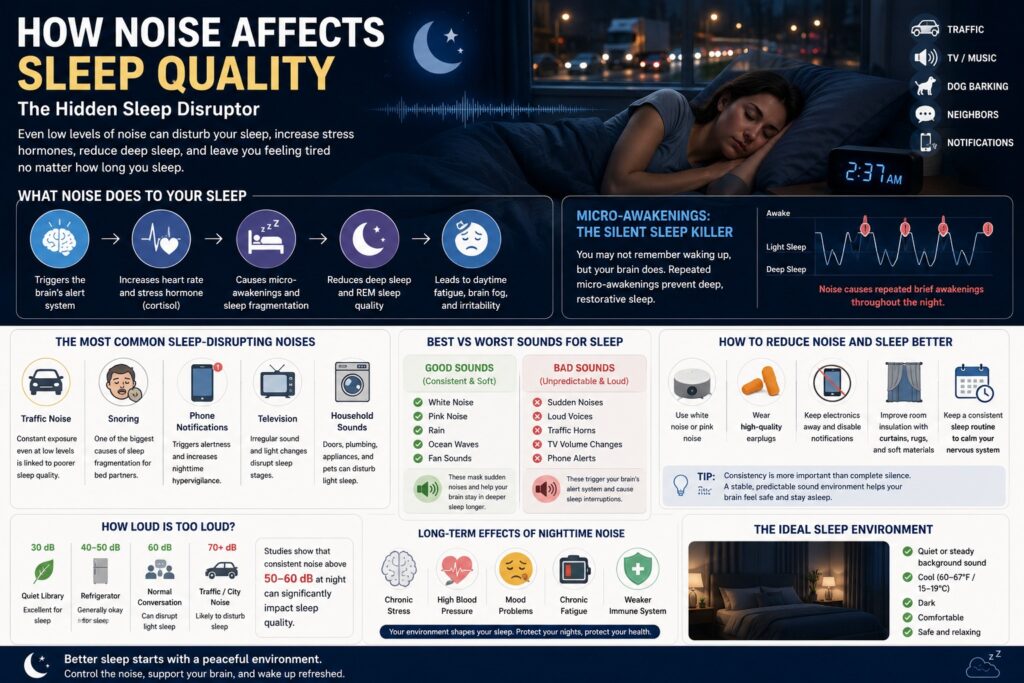
How Noise Affects Sleep Quality: The Hidden Sleep Disruptor (2026 Guide)
Introduction
Most people think sleep disruption requires something dramatic.
A loud alarm.
Construction outside the window.
A barking dog.
But the brain is far more sensitive during sleep than most people realize.
Even relatively low levels of nighttime noise can fragment sleep architecture, increase stress hormone activity, reduce deep sleep quality, and leave people waking up exhausted despite technically sleeping for enough hours.
The strange part is that many people never fully remember these disruptions.
The body reacts even when the conscious mind does not.
This is why someone can sleep through the night yet still wake feeling mentally foggy, physically tired, or unusually irritable the next day.
The brain does not simply “turn off” during sleep.
It continues monitoring the environment for potential threats, changes, and sensory information throughout the night.
From an evolutionary perspective, this makes sense.
Complete unconsciousness would have been dangerous for human survival.
Modern environments, however, constantly expose the brain to sounds it was never designed to process continuously during rest:
- traffic
- televisions
- notifications
- neighbors
- city noise
- snoring
- appliances
- late-night entertainment
- inconsistent environmental sounds
This guide explains the science behind noise and sleep quality, why even small sounds affect the sleeping brain, the difference between harmful and helpful sounds, and how to create an environment that allows deeper and more restorative sleep.
Why the Brain Reacts to Noise During Sleep
Sleep is not complete sensory shutdown.
The brain continues monitoring external information throughout the night, especially sounds.
This process is partially controlled by a survival system known as the “sentinel hypothesis.”
Even while sleeping, the brain maintains a reduced level of environmental awareness to detect potential danger.
This means sounds can still trigger:
- micro-awakenings
- stress responses
- increased heart rate
- cortisol release
- shifts into lighter sleep stages
Importantly, these disruptions often occur without full conscious awakening.
A person may have no memory of waking up at all.
But the nervous system still experiences interrupted recovery.
What Are Micro-Awakenings?
Micro-awakenings are extremely brief transitions toward wakefulness that may last only a few seconds.
Most people never remember them.
However, they can significantly disrupt sleep quality when repeated throughout the night.
Noise is one of the biggest triggers.
Repeated sleep fragmentation reduces:
- deep sleep
- REM sleep continuity
- nervous system recovery
- emotional regulation
- physical restoration
The result is often:
- daytime fatigue
- brain fog
- irritability
- reduced concentration
- poor recovery
- increased stress sensitivity
People frequently underestimate how much environmental noise contributes to chronic fatigue.
Why Sudden Sounds Are More Disruptive
The sleeping brain responds especially strongly to unpredictable sounds.
Consistent background sounds are generally easier for the brain to adapt to.
Sudden irregular sounds create stronger nervous system activation because unpredictability signals potential danger.
Examples include:
- doors slamming
- barking dogs
- phone notifications
- traffic horns
- loud voices
- sudden television volume changes
The brain prioritizes novelty and unpredictability.
Even moderate sounds become highly disruptive when inconsistent.
Noise and Stress Hormones
Nighttime noise exposure activates stress systems even during sleep.
Research shows that environmental noise can increase:
- cortisol
- adrenaline
- heart rate
- sympathetic nervous system activation
This prevents the body from fully entering restorative parasympathetic recovery states.
Over time, chronic nighttime noise exposure may contribute to:
- elevated stress levels
- higher blood pressure
- mood instability
- reduced recovery
- chronic fatigue
Sleep quality is not determined only by whether someone stays unconscious.
It depends on how deeply the nervous system can relax during the night.
How Noise Reduces Deep Sleep
Deep sleep is the most physically restorative sleep stage.
This is when:
- tissue repair increases
- growth hormone releases
- immune function strengthens
- nervous system recovery occurs
Noise fragmentation reduces the amount and continuity of deep sleep.
Even when people remain technically asleep, the brain may shift repeatedly into lighter sleep stages in response to environmental sounds.
This reduces the overall restorative quality of sleep.
People often describe this sensation as:
- “light sleep”
- “restless sleep”
- “sleeping but not recovering”
Noise and REM Sleep
REM sleep is particularly important for:
- emotional processing
- memory consolidation
- learning
- emotional regulation
Noise disruption during REM sleep may increase:
- emotional instability
- irritability
- anxiety sensitivity
- mental fatigue
This is one reason why poor sleep environments often affect mood so strongly.
The emotional brain becomes less well-regulated after fragmented REM sleep.
The Most Common Sleep-Disrupting Noises
Traffic Noise
Urban environments expose people to constant low-grade nighttime stimulation.
Even when traffic sounds seem “normal,” the brain continues processing them during sleep.
Research consistently links traffic noise exposure with poorer sleep quality.
Snoring
A partner’s snoring is one of the most common causes of chronic sleep fragmentation.
Even when the snorer sleeps deeply, the other person’s brain may experience repeated nighttime micro-awakenings.
Long-term sleep disruption from snoring can significantly affect:
- mood
- energy
- relationship quality
- daytime functioning
Phone Notifications
Notification sounds are particularly disruptive because the brain associates them with social relevance and urgency.
Even anticipation of notifications may increase nighttime hypervigilance.
Television Noise
Sleeping with the television on creates irregular auditory stimulation throughout the night.
Dialogue, changing volume levels, and light exposure all fragment sleep architecture.
Household Noise
Doors, plumbing sounds, footsteps, appliances, and pets can all contribute to repeated nighttime arousal.
People living in high-noise environments often adapt psychologically but remain physiologically affected.
Can the Brain Get Used to Noise?
Partially.
People often become consciously less aware of familiar sounds over time.
But physiological responses may still continue during sleep.
This means someone may claim:
“I’m used to the noise.”
Yet still experience:
- elevated stress markers
- fragmented sleep
- reduced deep sleep
- increased fatigue
The brain adapts imperfectly.
White Noise: Why It Helps
Unlike unpredictable sounds, white noise creates stable auditory masking.
White noise reduces the contrast between background silence and sudden environmental noises.
This makes disruptive sounds less noticeable to the sleeping brain.
White noise may help:
- babies
- light sleepers
- shift workers
- city residents
- anxious sleepers
The key is consistency.
Stable sound environments are easier for the brain to process safely during sleep.
Pink Noise vs White Noise
Some research suggests pink noise may support sleep even more effectively than white noise.
Pink noise contains softer lower-frequency sound patterns that resemble:
- rainfall
- wind
- ocean waves
Some studies suggest pink noise may improve:
- deep sleep stability
- memory consolidation
- sleep continuity
Many people simply choose whichever sound feels calming and consistent.
The Ideal Sleep Sound Environment
The best sleep environment is usually:
- quiet
- cool
- dark
- predictable
However, complete silence is not always necessary.
In some environments, stable soft background noise may actually improve sleep quality more than silence interrupted by sudden sounds.
Consistency matters more than absolute silence.
Practical Ways to Reduce Noise Disruption
Use White Noise
White noise machines, fans, or calming audio can reduce sudden sound disruption.
Wear Earplugs
High-quality sleep earplugs may dramatically improve sleep quality for light sleepers or noisy environments.
Reduce Bedroom Electronics
Phones, televisions, and notification devices increase unnecessary nighttime stimulation.
Improve Bedroom Insulation
Curtains, rugs, weather stripping, and soft materials help absorb environmental sound.
Keep Consistent Sleep Routines
A calm nervous system is generally less reactive to minor environmental disturbances.
Stress management indirectly improves noise resilience during sleep.
When Noise Becomes a Serious Health Issue
Chronic nighttime noise exposure may contribute to:
- insomnia
- chronic fatigue
- anxiety
- elevated blood pressure
- cardiovascular stress
- mood disorders
People living in consistently noisy environments often underestimate the cumulative physiological burden over time.
Sleep is where recovery happens.
When recovery becomes repeatedly interrupted, the effects gradually spread into every system of the body.
Conclusion
Noise affects sleep far more deeply than most people realize.
The sleeping brain continues monitoring the environment throughout the night, and repeated sound disruptions fragment sleep architecture even when full awakenings are not remembered consciously.
The result is often lighter sleep, reduced deep sleep, poorer emotional recovery, increased stress activation, and chronic daytime fatigue.
Protecting sleep sometimes means protecting the nervous system from unnecessary nighttime stimulation.
The goal is not necessarily perfect silence.
The goal is predictability, safety, and calm.
Because the deeper the brain feels safe enough to sleep, the deeper the body can finally recover.
📌 Tags
Noise and Sleep Quality, Sleeping With Noise, Better Sleep, White Noise for Sleep, Sleep Environment, Sleep Science, Nighttime Noise, Deep Sleep, REM Sleep, Sleep Interruption, Pink Noise, Sleep Recovery, Healthy Sleep Habits, Noise Pollution and Sleep, Relaxing Sounds for Sleep