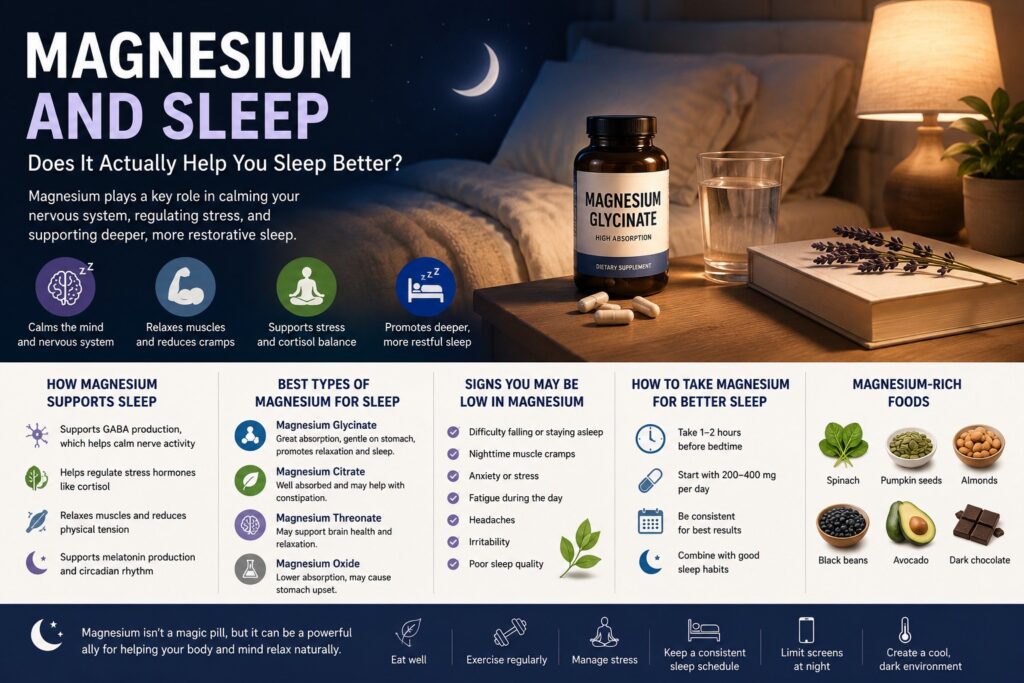
Magnesium and Sleep: Does It Actually Help You Sleep Better? (2026 Guide)
Introduction
Magnesium has become one of the most talked-about sleep supplements in the world.
Search interest has exploded over the last several years. Social media is filled with nighttime magnesium routines, “sleepy mocktails,” recovery stacks, and claims that magnesium can dramatically improve sleep quality almost overnight.
For some people, the results feel surprisingly real.
They fall asleep faster. Their body feels calmer at night. Muscle tension decreases. Nighttime anxiety softens. Sleep feels deeper and more restorative.
For others, magnesium appears to do almost nothing.
This creates understandable confusion.
Is magnesium actually effective for sleep, or is it simply another wellness trend amplified by the internet?
The answer is more nuanced than most people expect.
Magnesium is not a sedative that forcibly shuts down the brain. Instead, it works indirectly through multiple biological systems involved in nervous system regulation, stress response control, muscle relaxation, and sleep architecture support.
In people who are deficient, chronically stressed, highly stimulated, or sleeping poorly due to nervous system dysregulation, magnesium can meaningfully improve sleep quality.
But understanding how magnesium works — and when it actually helps — matters far more than simply taking random supplements before bed.
This guide explains the science behind magnesium and sleep, the types of magnesium that may support sleep best, the symptoms of low magnesium, and the practical reality of what magnesium can and cannot do for sleep quality.
What Is Magnesium?
Magnesium is an essential mineral involved in more than 300 biochemical reactions throughout the body.
It plays major roles in:
- nervous system regulation
- muscle function
- energy production
- blood sugar control
- stress response regulation
- cardiovascular health
- neurotransmitter activity
Despite its importance, magnesium deficiency or insufficiency is surprisingly common.
Modern diets high in processed foods often contain lower magnesium levels than whole-food diets rich in:
- leafy greens
- nuts
- seeds
- legumes
- whole grains
At the same time, chronic stress itself increases magnesium depletion.
This creates a cycle where stress reduces magnesium levels while low magnesium further worsens stress sensitivity and nervous system activation.
Sleep becomes one of the first systems affected.
How Magnesium Affects Sleep
Magnesium supports sleep through several overlapping mechanisms.
Importantly, magnesium does not function like prescription sleeping pills.
It works more like a nervous system regulator.
Nervous System Relaxation
One of magnesium’s most important roles involves regulating excitatory and inhibitory nervous system activity.
The brain constantly balances stimulation and relaxation.
Excitatory neurotransmitters increase alertness and activity.
Inhibitory neurotransmitters help calm neural firing and support relaxation.
Magnesium helps regulate this balance by supporting GABA activity.
GABA is the brain’s primary inhibitory neurotransmitter and plays a major role in reducing nervous system activation before sleep.
When GABA activity increases:
- mental activity slows
- muscle tension decreases
- nervous system arousal lowers
- relaxation becomes easier
This is one reason magnesium may help people who feel “wired but tired” at night.
Stress and Cortisol Regulation
Chronic stress is one of the biggest modern sleep disruptors.
High cortisol levels increase nighttime alertness, reduce deep sleep quality, and make it harder for the nervous system to transition into recovery mode.
Magnesium appears to help regulate stress response activity through effects on the hypothalamic-pituitary-adrenal axis.
Low magnesium levels are associated with:
- higher stress sensitivity
- increased anxiety
- elevated cortisol
- poorer sleep quality
Some people notice magnesium’s biggest sleep benefit not as sedation, but as reduced nighttime tension and calmer mental activity.
Muscle Relaxation
Magnesium also plays an important role in muscle contraction and relaxation.
Low magnesium levels may contribute to:
- muscle tightness
- nighttime cramps
- restless sensations
- physical tension
This is particularly relevant for people whose sleep problems are strongly physical rather than purely mental.
Athletes, highly stressed individuals, and people with physically demanding lifestyles may benefit most from this aspect of magnesium support.
Sleep Architecture Support
Some research suggests magnesium may modestly improve:
- sleep onset
- sleep efficiency
- deep sleep quality
- nighttime awakenings
However, the effects are generally subtle rather than dramatic.
Magnesium is best understood as a supportive recovery tool rather than a knockout sleep solution.
Signs You May Be Low in Magnesium
True severe magnesium deficiency is uncommon.
But mild insufficiency appears relatively widespread.
Possible signs include:
- difficulty relaxing
- muscle twitches
- nighttime cramps
- anxiety
- stress sensitivity
- poor sleep quality
- fatigue
- headaches
- irregular sleep patterns
Importantly, these symptoms are non-specific.
They can result from many causes.
But chronic stress combined with poor diet and sleep problems increases the likelihood that magnesium status may be contributing.
What the Research Says
Research on magnesium and sleep shows promising but mixed results.
Some studies demonstrate meaningful improvements in:
- sleep quality
- sleep onset
- insomnia severity
- stress reduction
Particularly in older adults and individuals with poor baseline sleep.
A study published in the Journal of Research in Medical Sciences found that magnesium supplementation improved sleep efficiency, sleep time, and melatonin levels in older adults with insomnia.
Other studies show more modest effects.
This inconsistency likely exists because magnesium works best when low magnesium status or nervous system hyperactivation are part of the underlying sleep problem.
Someone sleeping poorly due to severe anxiety, excessive caffeine, sleep apnea, or circadian disruption may not experience dramatic improvement from magnesium alone.
Magnesium works best as part of a broader sleep-supportive lifestyle.
Best Types of Magnesium for Sleep
Not all magnesium supplements are identical.
Different forms affect the body differently.
Magnesium Glycinate
Magnesium glycinate is one of the most commonly recommended forms for sleep.
It combines magnesium with glycine, an amino acid associated with calming nervous system effects.
This form is generally:
- well absorbed
- gentle on digestion
- less likely to cause diarrhea
- commonly used for stress and sleep support
For many people, this is the preferred sleep-focused form.
Magnesium Citrate
Magnesium citrate is widely available and well absorbed.
However, it has stronger digestive effects and may function partially as a laxative in some individuals.
Useful for constipation support, but not always ideal before bed for sensitive people.
Magnesium Threonate
Magnesium threonate has gained attention because it may cross the blood-brain barrier more effectively than some other forms.
Research remains limited, but it is sometimes marketed for cognitive support and brain health alongside sleep support.
Magnesium Oxide
Magnesium oxide is inexpensive but poorly absorbed compared to other forms.
It is less ideal for sleep-focused supplementation.
Can Magnesium Help Anxiety at Night?
For some individuals, yes.
Especially when nighttime anxiety is strongly physical.
People sometimes describe:
- chest tightness
- muscle tension
- internal restlessness
- nervous system overactivation
Magnesium may help reduce the intensity of this physical stress state.
However, magnesium is not a replacement for addressing:
- chronic stress
- excessive stimulation
- poor sleep habits
- unresolved anxiety disorders
Supplements work best when supporting healthy behaviors rather than replacing them.
How to Take Magnesium for Sleep
General practical guidelines include:
- taking magnesium 1–2 hours before bed
- combining it with calming nighttime routines
- using it consistently rather than occasionally
Many people combine magnesium with:
- reading
- stretching
- low lighting
- breathing exercises
- reduced screen exposure
The nervous system responds best to combined signals of safety and relaxation.
What Magnesium Cannot Fix
Magnesium is not a cure for every sleep problem.
It will not fully overcome:
- severe sleep apnea
- heavy evening caffeine use
- chronic alcohol disruption
- extreme stress overload
- poor sleep schedules
- excessive nighttime screen exposure
Many people expect supplements to compensate for biologically disruptive habits.
Sleep physiology rarely works that way.
Foundational sleep behaviors still matter most.
Natural Ways to Improve Magnesium Status
Supplements are not the only option.
Magnesium-rich foods include:
- spinach
- pumpkin seeds
- almonds
- black beans
- avocado
- dark chocolate
- cashews
Improving overall diet quality often improves sleep quality indirectly through multiple pathways beyond magnesium alone.
Conclusion
Magnesium can meaningfully support sleep quality for some people, particularly those experiencing stress-related sleep disruption, muscle tension, nervous system hyperactivation, or mild magnesium insufficiency.
Its effects are usually subtle but real.
Magnesium does not force sleep.
Instead, it helps create the physiological conditions that allow sleep to happen more naturally.
The biggest benefits tend to appear when magnesium is combined with:
- consistent sleep schedules
- lower evening stress
- reduced screen exposure
- healthy sleep environments
- regular physical activity
Like most effective sleep interventions, magnesium works best as part of a system rather than as a standalone shortcut.
Sometimes better sleep does not come from overpowering the brain into unconsciousness.
Sometimes it comes from helping the nervous system finally relax.
📌 Tags
Magnesium and Sleep, Magnesium for Sleep, Better Sleep, Sleep Supplements, Sleep Science, Magnesium Glycinate, Deep Sleep, Natural Sleep Aid, Stress and Sleep, Sleep Recovery, Magnesium Deficiency, Nighttime Anxiety, Sleep Tips, Relaxation and Sleep, Nervous System Health