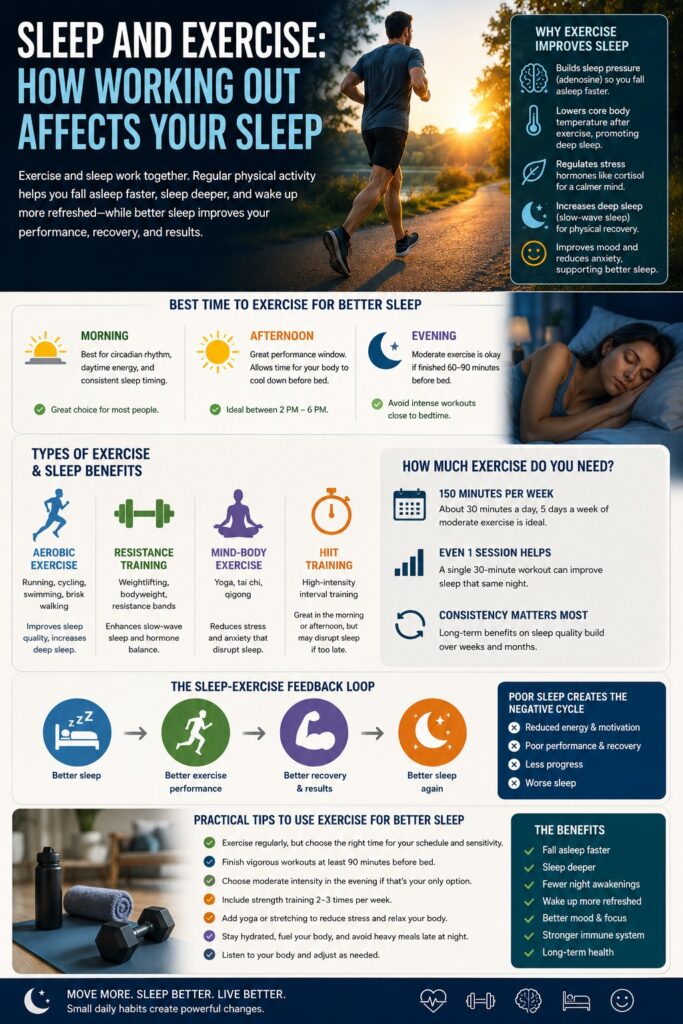
Sleep and Exercise: How Working Out Affects Your Sleep
Introduction
The relationship between exercise and sleep is one of the most well-supported and mutually beneficial connections in health science. Regular physical activity consistently improves sleep quality, reduces the time it takes to fall asleep, increases the proportion of deep restorative sleep, and decreases the frequency of nighttime awakenings. At the same time, adequate sleep enhances exercise performance, accelerates physical recovery, and supports the hormonal environment that makes training effective.
These two pillars of health do not merely coexist — they actively reinforce each other. People who exercise regularly sleep better, and people who sleep better exercise more effectively. Understanding the specific mechanisms through which exercise improves sleep — and the nuances of timing, intensity, and type that determine whether a given workout helps or hinders sleep on a particular night — allows you to use physical activity as one of the most powerful natural sleep interventions available.
This guide covers the complete science of how exercise affects sleep, why it works, when to exercise for maximum sleep benefit, and how to structure your physical activity to support rather than disrupt the sleep quality you are working to improve.
How Exercise Improves Sleep: The Core Mechanisms
Exercise improves sleep through several distinct biological pathways that operate simultaneously and compound over time with consistent training.
Adenosine accumulation is one of the most direct mechanisms. Adenosine is the chemical byproduct of neural and metabolic activity that accumulates in the brain throughout the day, building the sleep pressure that makes falling asleep progressively easier as the day advances. Physical activity accelerates adenosine production beyond what sedentary wakefulness generates, building stronger sleep pressure by the time evening arrives. This is why people who exercise regularly tend to fall asleep faster and feel more genuinely sleepy at their intended bedtime — their sleep pressure is more robustly built by the end of the day.
Core body temperature regulation provides another pathway. Exercise raises core body temperature significantly during activity. In the hours following exercise, the body works to dissipate this heat, producing a drop in core temperature that mirrors — and reinforces — the natural temperature decline that initiates deep sleep. When exercise is timed appropriately, this post-exercise temperature drop coincides with the evening temperature decline that the circadian rhythm produces, creating a combined thermal signal that supports sleep onset and deepens the early sleep cycles.
Cortisol regulation is a third critical mechanism. Acute exercise raises cortisol temporarily — a necessary part of the physiological stress response that drives adaptation. But regular exercise, over weeks and months, reduces baseline cortisol levels and improves the efficiency of the hypothalamic-pituitary-adrenal axis stress response. Chronically elevated cortisol is one of the most common causes of poor sleep quality — it suppresses melatonin, maintains sympathetic nervous system activation, and reduces deep sleep. Regular exercise directly addresses this underlying cause of sleep disruption.
Slow-wave sleep promotion is perhaps the most directly restorative effect of exercise on sleep architecture. Research consistently shows that regular exercisers spend significantly more time in deep slow-wave sleep than sedentary individuals — the stage responsible for physical repair, immune strengthening, growth hormone release, and the brain’s glymphatic waste-clearing process. The physical fatigue generated by exercise appears to signal to the brain that deeper physical restoration is required, increasing the proportion of the night allocated to this most restorative stage.
Anxiety and mood regulation complete the picture. Exercise is one of the most evidence-supported interventions for anxiety and depression — conditions that are among the leading causes of sleep disruption. Regular moderate exercise reduces baseline anxiety through multiple mechanisms: lowering cortisol, increasing BDNF production, promoting the release of endorphins and serotonin, and reducing the physiological hyperarousal that anxiety produces. By addressing the emotional and psychological barriers to sleep, exercise improves sleep quality through a pathway that is entirely distinct from its direct physiological effects.
What the Research Shows
The evidence base for exercise as a sleep intervention is extensive and spans multiple populations, exercise types, and study designs.
A meta-analysis published in the journal Mental Health and Physical Activity, examining data from multiple controlled trials, found that regular exercise significantly improved sleep quality, reduced sleep onset latency, increased total sleep time, and decreased daytime sleepiness compared to sedentary controls. The effects were observed across aerobic exercise, resistance training, and mind-body exercise modalities, suggesting that the type of exercise matters less than its regularity.
Research from Northwestern University found that previously sedentary adults with insomnia who began a moderate aerobic exercise program reported significant improvements in sleep quality, mood, and vitality within weeks — with sleep quality improvements comparable to those produced by sleep medication in some measures, without the dependency or side effect concerns.
A study published in the journal Sleep Medicine found that a single bout of moderate aerobic exercise produced measurable improvements in sleep onset and sleep depth on the same night for people with chronic insomnia — demonstrating that exercise improves sleep acutely as well as over the long term with regular practice.
The Timing Question: When to Exercise for Better Sleep
The timing of exercise relative to bedtime is the most frequently debated and most individually variable aspect of the exercise-sleep relationship. The conventional wisdom — that exercise close to bedtime disrupts sleep — is partially supported by research but significantly more nuanced than the blanket recommendation suggests.
Morning exercise produces the most consistently positive effects on nighttime sleep across the broadest range of individuals. Morning physical activity, particularly when combined with outdoor light exposure, produces a sharp cortisol awakening response that drives daytime alertness, calibrates the circadian rhythm, and sets a stronger biological timer for evening sleepiness.
Afternoon exercise is also broadly beneficial for sleep and may produce the strongest performance benefits due to the alignment of exercise with the natural peak in core body temperature and muscular output that occurs in the mid-to-late afternoon.
Evening exercise is more individual. Vigorous aerobic exercise too close to bedtime can elevate core body temperature, heart rate, and cortisol at a time when the body needs these parameters to be declining. In sensitive individuals, this may delay sleep onset and reduce deep sleep quality.
However, moderate-intensity evening exercise is acceptable for most people and may be preferable to no exercise at all.
Type of Exercise and Sleep Quality
Different types of exercise affect sleep through partially overlapping but distinct mechanisms.
Aerobic Exercise
Running, cycling, swimming, and brisk walking consistently produce strong improvements in sleep onset, deep sleep, and total sleep time.
Resistance Training
Weightlifting and resistance exercises support muscle repair, hormonal balance, and slow-wave sleep quality.
Mind-Body Exercise
Yoga, tai chi, and stretching combine physical movement with parasympathetic nervous system activation, making them particularly useful for stress-related sleep problems.
High-Intensity Training
HIIT workouts can improve sleep long term but may disrupt sleep if performed too close to bedtime due to increased nervous system activation.
How Much Exercise Is Needed to Improve Sleep
The research does not require extreme training volumes to improve sleep.
Approximately 150 minutes of moderate exercise per week — around 30 minutes on most days — consistently improves sleep quality in research studies.
Even a single 30-minute workout can improve sleep quality that same night.
The biggest benefits come from consistency rather than intensity.
The Sleep-Exercise Feedback Loop
Exercise improves sleep.
Better sleep improves exercise performance.
This creates a positive feedback cycle.
Deep sleep supports:
- muscle recovery
- hormone production
- nervous system repair
- glycogen restoration
- physical performance
Meanwhile, sleep deprivation reduces:
- strength
- endurance
- motivation
- reaction time
- recovery capacity
People who consistently prioritize both sleep and exercise often experience dramatic improvements in energy, mood, recovery, and long-term health.
Practical Recommendations
- Exercise consistently throughout the week
- Prioritize morning or afternoon workouts when possible
- Avoid very intense exercise close to bedtime
- Include resistance training 2–3 times weekly
- Add yoga or stretching if stress affects your sleep
- Focus on consistency over perfection
Conclusion
Exercise and sleep are deeply connected biological systems that continuously reinforce one another.
Regular physical activity is one of the most effective natural sleep interventions available. It improves sleep onset, deep sleep, stress regulation, emotional recovery, and overall sleep quality.
At the same time, better sleep improves exercise performance, recovery, and long-term physical adaptation.
The key is consistency, sustainable habits, and understanding how timing and intensity affect your individual nervous system.
Move more. Sleep deeper. Recover better.
Over time, the cycle becomes one of the most powerful health upgrades available.
Tags
Exercise and Sleep, Working Out and Sleep, Sleep Quality Exercise, Better Sleep, Sleep Science, Morning Exercise Sleep, Evening Exercise Sleep, Aerobic Exercise Sleep, Resistance Training Sleep, Yoga and Sleep, Deep Sleep Exercise, Cortisol and Exercise, Sleep Deprivation Exercise, Adenosine Sleep, Circadian Rhythm