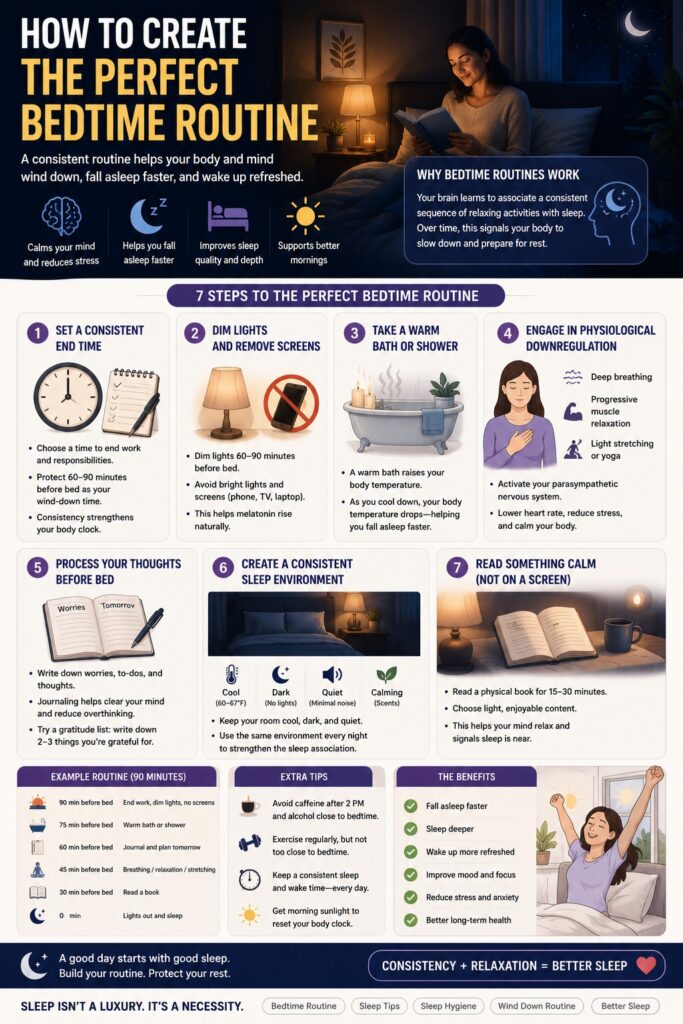
How to Create the Perfect Bedtime Routine
Introduction
Most people approach bedtime reactively. The day ends, exhaustion accumulates, and at some point — often later than intended — they find themselves in bed, phone in hand, waiting for sleep to arrive. There is no deliberate transition between the demands of the day and the stillness of the night. Sleep is expected to happen automatically, on demand, regardless of the physiological and cognitive state the body is in when the lights go off.
This approach works inconsistently at best. Sleep is not a switch that can be flipped at will. It is a biological process that requires a gradual transition — a coordinated shift in hormones, nervous system activity, brain wave patterns, and core body temperature that takes time and the right conditions to unfold. Without a deliberate pre-sleep period that supports this transition, the body arrives at bedtime in a state that is frequently incompatible with quick, deep, and restorative sleep.
A bedtime routine is not a luxury or a productivity hack. It is a biological necessity that works by conditioning the nervous system to recognize a consistent sequence of signals as the approach of sleep — and by actively creating the physiological conditions that sleep requires. This guide covers the science behind why bedtime routines work, what the most effective ones include, and how to build one that is sustainable and genuinely transformative for sleep quality.
The Science Behind Why Bedtime Routines Work
The effectiveness of a consistent bedtime routine is grounded in two distinct but complementary mechanisms: conditioned responses and physiological preparation.
The conditioned response mechanism is straightforward. Your brain is a pattern-recognition system that forms associations between environmental and behavioral sequences and physiological states through repeated pairing. When you perform the same sequence of activities before bed every night — the same order, the same timing, the same sensory environment — your brain learns to associate that sequence with the approaching state of sleep. Over weeks and months, simply beginning the routine triggers an automatic shift toward relaxation and sleepiness, because the sequence has been paired with sleep onset thousands of times.
This is the same principle behind Pavlovian conditioning. The routine becomes a powerful cue that initiates the physiological preparation for sleep before any specific technique is applied. This is why the consistency of a routine matters more than its specific content — a simple routine followed reliably every night is more effective than an elaborate one practiced sporadically.
The physiological preparation mechanism is equally important. The activities that constitute an effective bedtime routine — reducing light exposure, lowering physiological arousal, decreasing core body temperature, engaging the parasympathetic nervous system — directly create the biological conditions that sleep onset requires. The routine is not merely signaling sleep. It is building it.
Step 1: Set a Consistent End Time for the Day
The first element of an effective bedtime routine is not a specific activity but a boundary: a consistent time each evening at which the demands of the day are deliberately closed.
Work tasks, emails, planning, and problem-solving maintain the prefrontal cortex in an active, engaged state that is incompatible with sleep onset. More importantly, they generate or sustain the cortisol elevation that prevents the nervous system from shifting into its rest state. Without a clear boundary between the day’s demands and the pre-sleep period, cognitive activation persists indefinitely — and the wind-down period is perpetually postponed by one more task, one more message, one more thing to check.
Setting a specific time — 60 to 90 minutes before your intended sleep time — at which all work and cognitively demanding activities stop creates the protected space that an effective wind-down requires. This boundary does not need to be rigid or stress-inducing. It simply needs to exist consistently enough for the nervous system to begin recognizing it as the signal that the day is closing.
Step 2: Dim Your Lights and Remove Screens
Light management is the most physiologically impactful component of the pre-sleep period and should begin as soon as the day’s demands are closed.
Bright light and blue light from overhead fixtures and screens suppress melatonin production and signal to the brain’s circadian clock that daytime conditions are present. Even 30 minutes of bright light exposure in the hour before bed can delay melatonin onset by one to two hours in sensitive individuals, shifting the biological readiness for sleep significantly later than the intended bedtime.
Dimming overhead lights and switching to warm amber-toned lamps or candles in the 60 to 90 minutes before bed allows melatonin to rise on schedule and supports the drop in core body temperature that sleep initiation requires. The brain responds to light color temperature as a time-of-day signal — warm light communicates evening, cool light communicates daytime — making this a direct and effective way to work with circadian biology.
Screens require particular attention. Beyond the light they emit, electronic devices deliver cognitively stimulating content that maintains prefrontal cortex activation and triggers dopamine responses incompatible with the mental disengagement that sleep requires. Blue light filters and night modes reduce the light problem but do nothing about the stimulation problem. Putting screens away completely — phone included — at least 60 minutes before bed is one of the highest-impact single changes available for improving sleep onset and depth.
Step 3: Take a Warm Bath or Shower
A warm bath or shower taken 60 to 90 minutes before bed is one of the most evidence-supported individual components of a bedtime routine, with direct physiological effects on sleep onset.
The mechanism involves core body temperature regulation. Sleep onset requires a drop in core body temperature of approximately one to two degrees Fahrenheit. A warm bath temporarily raises skin temperature and dilates the peripheral blood vessels, which accelerates the rate at which heat is lost from the body’s surface. When you step out of the bath, the rapid peripheral heat loss produces a faster-than-normal core temperature decline that directly facilitates and accelerates the initiation of sleep.
Research published in Sleep Medicine Reviews found that a warm bath in this pre-sleep window reduced sleep onset time by an average of 10 minutes and improved subjective sleep quality. The effect is not dependent on bath temperature — a warm rather than hot bath is sufficient and preferable, as excessively hot water can temporarily elevate core temperature in ways that have the opposite effect.
Beyond the physiological mechanism, the ritual of bathing serves as a powerful conditioned signal within the routine sequence — a clear sensory demarcation between the day and the pre-sleep period that the brain learns to associate with approaching sleep.
Step 4: Engage in Physiological Downregulation
The central purpose of the pre-sleep period is to shift the nervous system from its sympathetic alert state to its parasympathetic rest state. This shift does not happen spontaneously in the presence of stress, residual cognitive activation, or the stimulating content of modern evening entertainment. It requires deliberate physiological intervention.
Several techniques have strong evidence for producing this shift.
Diaphragmatic breathing is the most accessible and most immediately effective. Slow, deep breathing from the abdomen — particularly with an extended exhale — activates the vagus nerve through the respiratory sinus arrhythmia mechanism, producing measurable reductions in heart rate, blood pressure, and cortisol within minutes. The 4-7-8 technique — inhale for 4 seconds, hold for 7, exhale for 8 — uses the extended exhale to maximize vagal activation. Physiological sighing — a double inhale through the nose followed by a long, slow exhale through the mouth — produces an even more rapid reduction in physiological arousal and can be used as a quick reset at any point in the routine.
Progressive muscle relaxation involves systematically tensing and then releasing each muscle group from the feet upward to the face. The contrast between tension and release produces deep physical relaxation and draws conscious attention into the body, away from the cognitive rumination that maintains stress arousal. Research has consistently shown that progressive muscle relaxation practiced before bed reduces sleep onset time and improves sleep quality in people with stress-related sleep difficulties.
Light stretching or restorative yoga activates the parasympathetic nervous system through a combination of physical relaxation, breath regulation, and the proprioceptive input that signals safety and stillness to the nervous system. A 10 to 15 minute sequence of gentle floor-based stretches focusing on the hips, lower back, and shoulders — the areas where daily tension most commonly accumulates — produces meaningful reductions in physical arousal that support sleep onset.
Step 5: Process the Day’s Cognitive Content
One of the most significant barriers to sleep onset is the cognitive residue of the day — the unresolved concerns, unfinished tasks, and anticipatory worries that the mind continues to engage with long after the day has technically ended. Without a deliberate mechanism for processing and containing this content before bed, it follows you into the sleep period and maintains the prefrontal activation that prevents sleep.
Pre-sleep journaling is the most evidence-supported technique for managing this cognitive residue. Spending 5 to 10 minutes writing down the day’s unresolved thoughts, tomorrow’s priorities, and any concerns that are generating anxiety serves two functions simultaneously. It externalizes the content — moving it from working memory to paper, where the brain perceives it as having been acknowledged and set aside — and it creates a cognitive closure that reduces the urgency driving rumination.
Research from Baylor University found that participants who wrote a specific to-do list for the following day before bed fell asleep significantly faster than those who wrote about completed tasks, because forward-looking lists specifically address the anticipatory planning cognition that most commonly delays sleep onset.
The journaling does not need to be extensive or structured. Five minutes of free writing is sufficient to produce the offloading effect. The key is that it occurs consistently within the routine and before the actual sleep environment is entered — completing it in a different room than the bedroom maintains the bedroom’s association with sleep rather than with cognitive activity.
Gratitude reflection — briefly noting two or three specific things that went well or that you are grateful for during the day — has been shown in research to reduce bedtime cognitive arousal and improve sleep quality. It works by shifting the attentional focus from threat-monitoring — the default mode under stress — to positive content that activates different neural networks and supports the downward shift in arousal that sleep requires.
Step 6: Create a Consistent Sensory Environment
The sensory conditions of the pre-sleep environment and the sleep environment itself should be consistent enough to serve as reliable conditioned cues for sleep. Consistency across multiple sensory channels — visual, auditory, thermal, olfactory — strengthens the overall conditioned association between the environment and sleep.
Visual consistency involves the same lighting conditions, the same degree of tidiness and visual simplicity, and the same absence of work materials and screens in the sleep environment every night. A visually calm, uncluttered bedroom with warm, dim lighting signals safety and rest to the nervous system and reduces the visual stimulation that maintains cognitive arousal.
Auditory consistency can involve the same calming music, white noise, or silence every night. Consistency matters more than the specific choice — a consistent auditory environment that is repeated nightly becomes a conditioned sleep cue regardless of whether it is sound or silence.
Thermal consistency involves maintaining the bedroom at the cool temperatures — between 60 and 67 degrees Fahrenheit — that support the core body temperature drop sleep requires. Preparing the bedroom temperature before entering it — turning on a fan, adjusting the thermostat, or opening a window — becomes part of the routine sequence and serves as a conditioned cue in its own right.
Olfactory cues are among the most powerful conditioned signals available, because the olfactory system has a direct neural connection to the limbic system that bypasses the thalamic processing required for other sensory information. Using the same scent consistently in the pre-sleep environment — lavender, chamomile, or any personally calming fragrance — through a diffuser or pillow spray gradually acquires strong associations with sleep onset. Research has shown that lavender specifically has mild physiological anxiolytic effects through GABA receptor modulation that complement its conditioned association benefits.
Step 7: Use Calming Pre-Sleep Reading
Reading before bed — specifically reading a physical book rather than a screen-based text — is one of the most consistently recommended and broadly effective components of a bedtime routine. It serves multiple functions simultaneously.
Reading occupies the mind with gentle, absorbing content that prevents the rumination and worry that would otherwise fill the pre-sleep mental space. Unlike screens, a physical book provides this cognitive engagement without blue light emission or the algorithmically optimized stimulation of digital content. The act of reading in a fixed position — lying or sitting in the sleep environment — also reinforces the physical association between the space and a calm, drowsy state.
Research from the University of Sussex found that reading for just six minutes reduced heart rate and muscle tension by 68 percent — more effectively than listening to music, taking a walk, or drinking tea — suggesting that reading produces a rapid and measurable shift in physiological arousal independent of the specific content.
The choice of reading material matters to some degree. Fiction — particularly narrative fiction that requires imaginative engagement rather than analytical processing — is more effective for pre-sleep reading than non-fiction that demands critical thinking, evaluation, or generates new planning concerns.
Building Your Routine: A Practical Template
An effective bedtime routine does not need to be elaborate to be effective. The following template represents a practical, evidence-based sequence that can be adapted to individual preferences and time constraints.
Beginning 90 minutes before your intended sleep time, close all work and cognitively demanding activities. Dim overhead lights and put screens away. If time allows, take a warm bath or shower. Spend 5 to 10 minutes journaling — writing tomorrow’s tasks or processing the day’s cognitive residue. Practice 5 to 10 minutes of diaphragmatic breathing, progressive muscle relaxation, or light stretching. Move to the bedroom, which should be cool, dark, and quiet. Read a physical book for 15 to 30 minutes until genuine sleepiness arrives. Put the book down and allow sleep to come.
The entire sequence takes 60 to 90 minutes and can be compressed or expanded based on available time. The most important elements are the consistent sequence, the light management, and the physiological downregulation — the other components add value but are not individually essential.
Conclusion
A bedtime routine is not a collection of nice-to-have habits. It is a deliberately engineered transition — a sequence of specific behaviors that collectively create the physiological conditions sleep requires while simultaneously conditioning the nervous system to recognize the approach of sleep through repeated association.
The routines that produce the most meaningful improvements in sleep quality share three characteristics: they are consistent in sequence and timing, they include specific physiological downregulation techniques that directly address the nervous system activation that disrupts sleep, and they are sustainable enough to be maintained as a daily practice rather than abandoned after initial enthusiasm fades.
Start with three or four elements that feel most relevant to your current situation and build from there. The routine does not need to be perfect from the first night — it needs to be consistent. And consistency, maintained over weeks and months, is what transforms a collection of evening habits into one of the most powerful tools available for improving sleep quality.
Better nights do not begin when your head hits the pillow. They begin 90 minutes earlier, with the deliberate choice to prepare.
📌 Tags
Bedtime Routine, Sleep Routine, How to Sleep Better, Better Sleep, Sleep Tips, Wind Down Routine, Sleep Hygiene, Melatonin and Light, Progressive Muscle Relaxation, Breathing for Sleep, Journaling for Sleep, Sleep Environment, Circadian Rhythm, Pre Sleep Routine, Deep Sleep, Healthy Sleep Habits, Night Routine, Sleep Quality, Relaxation Techniques, Natural Sleep Improvement